
Garage Door Won’t Close This Winter? A Sacramento Homeowner’s Guide
A door stuck open on a rainy evening is more than a nuisance. Here’s what to check when the opener clicks or flashes, how to prepare for an outage, and when California requires battery backup.
The remote clicks. The lights flash. The door stays open.
You’re home, it’s getting dark, and rain is blowing toward the garage. You press the remote again. The opener clicks, but the door won’t come down. Before you decide the motor is finished, look near the bottom of the tracks. A blocked or misaligned safety sensor can be enough to keep an otherwise working opener from closing.
That is different from a power outage. If the opener has no power, cleaning a sensor won’t bring it back. And if the door is crooked, a cable is loose, or a spring has broken, neither a new remote nor a backup battery will make the door safe to move. The first job is to work out which problem you actually have.
Start with these three clues
- Opener responds, but the door refuses to close: check the sensor path and your model’s diagnostic lights.
- Opener is completely silent during a confirmed outage: check whether it has a charged, working backup battery.
- Door hangs unevenly, drops, strains or has a loose cable: stop using it and call for service. Keep everyone away from the opening.
What happened at our Grass Valley service call
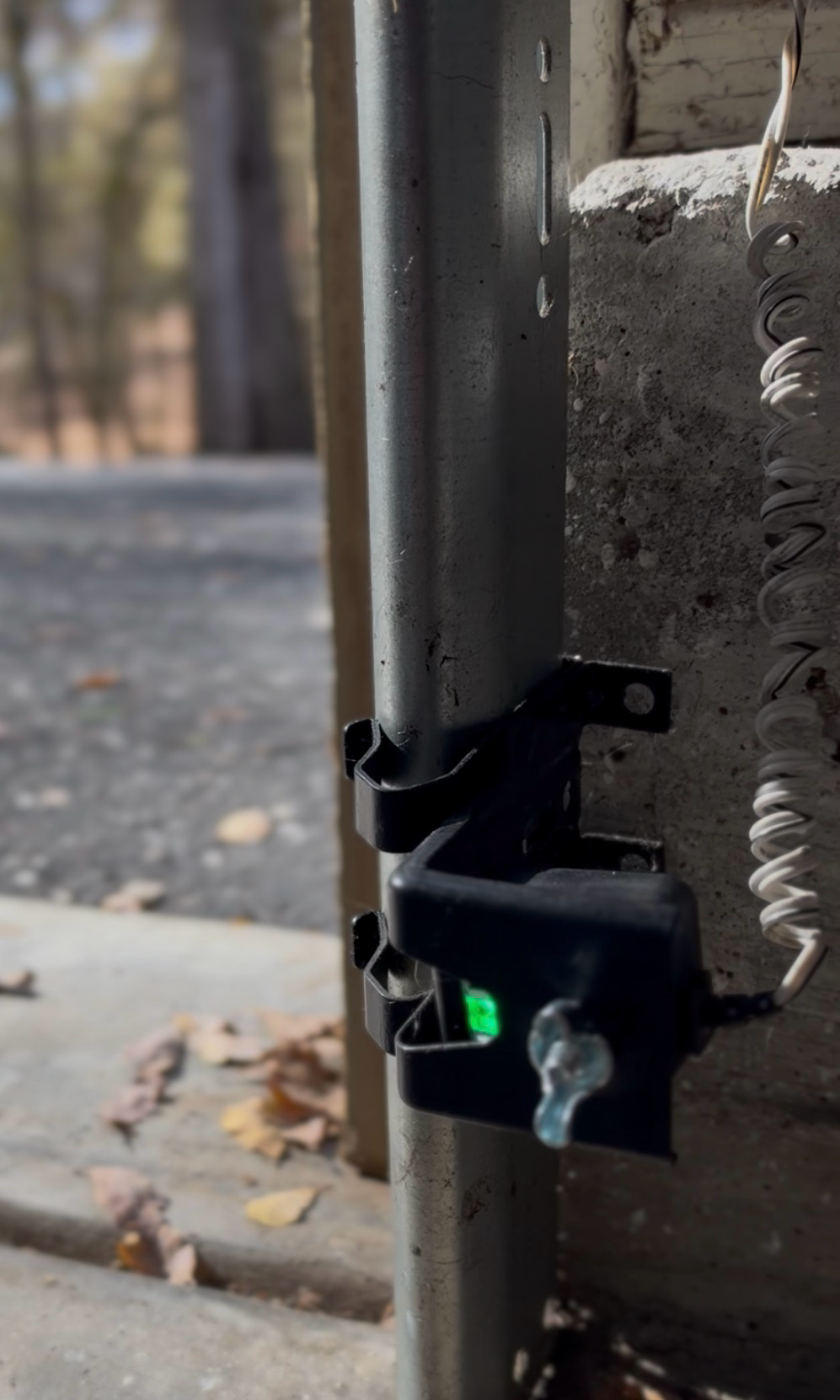
In the reel we shared today, November 18, we described a call in Grass Valley, CA 95949. The home had an insulated steel-back carriage-overlay door and a Chamberlain belt-drive opener. The remote produced clicking and flashing lights, but the door would not shut. A photo-eye sensor near the bottom of the track was blinking.
We cleaned the lens and aligned the sensor bracket. Once the beam was steady, the door closed smoothly. The photo above shows the sensor beside the track. This was a Grass Valley job—not a Sacramento installation—and it is a useful example of why we check the safety system before recommending a replacement opener.
A lens wipe solved part of this particular problem. It does not mean every flashing opener has the same fault. A damaged wire, loose mounting point or failing sensor needs a different repair.
Why this matters before Sacramento’s winter rain
A door left open exposes the garage to rain, windblown leaves and unwanted access. A broom shifted into the sensor path, a cobweb across a lens, or a bracket bumped while moving storage can turn into a frustrating evening. Check these things before wet weather arrives rather than waiting until you need to leave for work.
Don’t assume cold weather is the diagnosis. Leaves and dirt can obstruct the beam; moisture damage or a loose connection needs inspection. Direct sunlight can also interfere with a receiving sensor, even on a clear winter day. If the problem appears at the same time each afternoon, tell your technician—that clue can help.
For Sacramento, Elk Grove, Roseville and Citrus Heights homeowners, the practical winter check is the same: a clear opening, secure sensors, a door that travels normally, and a backup battery that actually works. Foothill homes in Auburn, Grass Valley and Nevada City should make the same checks before an outage, too.
Five things you can check without bypassing the sensors
Keep children and pets away, stay out from under the door, and start with a visual check. If the door is not sitting normally in its tracks, skip troubleshooting and call a technician. Follow your opener’s manual; sensor colors and diagnostic codes are not identical across brands.
- 1. Clear the beam. Move bins, brooms and boxes away from both sides of the opening. Remove leaves and cobwebs without touching moving parts.
- 2. Clean the lenses. With the door stationary, gently wipe each lens with a clean, soft cloth. Don’t soak the sensor or spray cleaner into its housing.
- 3. Read both indicator lights. Many Chamberlain and LiftMaster systems use an amber sending light and a green receiving light. A flickering or dark light is a clue, not a complete diagnosis; check the manual for your model.
- 4. Look for a bumped bracket or damaged wire. Don’t bend the track, splice wiring, or adjust springs. Disconnect power before any sensor adjustment and follow the manufacturer’s instructions; if unsure, leave alignment to a technician.
- 5. Verify safe operation after the issue is corrected. Follow the manual’s photo-eye test from outside the door’s path, using an object—not a person—to interrupt the beam. The separate contact-reversal test uses a 2×4 laid flat on the floor. If either test fails, stop automatic operation and arrange service.
A safety sensor is not an inconvenience to work around
The photo-eyes watch the opening while the door closes. A broken beam tells the opener to stop or reverse. Covering a sensor, taping the pair together or disabling the circuit takes away protection that a heavy moving door needs. Don’t increase closing force to fight a sensor problem, either.
UL 325 is the safety standard behind these protections, not the name of a federal law. California’s code has required an optical sensor, a tactile edge sensor or a similar protective device for covered residential openers since January 1, 1993, with a limited historical stock exception. It does not say every opener must use this exact style of photo-eye. On a photo-eye-equipped system, both sensors must be correctly installed and working; Chamberlain specifies a beam no higher than six inches above the floor.
A steady green light is helpful, but it is not a safety certification. The door still needs the manufacturer’s safety tests, a sound mechanical system and proper installation.
When the power goes out, will your car be stuck inside?
Without a working backup battery, an electric opener generally cannot run during an outage. A properly balanced, undamaged door may be opened manually according to its instructions—but lifting it is not easy for everyone. If someone in your household cannot safely lift the door, have a plan before the next outage.
Only use the emergency release when the door is fully closed and the door and spring system are intact, following your model’s manual. Never pull it on a door stuck open or partly open: a weak or broken spring can let the door fall. Never force a heavy door or try to repair a spring or cable yourself. If the closed door feels unusually heavy, stop.
If the garage is your only way to reach a vehicle, talk to a technician about safe access and a compatible battery-backup opener. Keep keys, remotes and a flashlight where you can find them. During an immediate threat, follow emergency instructions and call 911 when necessary—don’t delay getting to safety while trying to fix the garage door.
What California’s battery-backup law actually requires
Since July 1, 2019, California SB 969 requires residential automatic garage door openers manufactured for sale, sold, offered for sale or installed to include a battery-backup function designed to operate during an electrical outage. A replacement residential garage door also cannot be installed connected to an existing opener that does not meet those requirements.
That does not mean every older working opener without a battery suddenly became illegal to keep using. The law does not impose a blanket retrofit requirement on existing pre-2019 installations. Replacing the opener or connecting a replacement door is where the requirement matters. A sensor repair alone is not the same as a new opener installation.
Battery backup supplies power; it does not repair broken springs, straighten tracks or cure a sensor fault. Some models have different feature behavior while running on battery, so read the manual rather than assuming every light, app feature and safety-system behavior stays identical. Never use battery mode as a workaround for a known fault.
Test the battery before you need it
A battery compartment is not proof that the battery is healthy. Check the status indicator and your model’s testing instructions while utility power is available. If the door is operating normally and the manual permits it, disconnect utility power as directed, run the prescribed test from a safe position, then restore power and confirm charging. Don’t reach an overhead plug from an unstable ladder.
Chamberlain gives an approximate battery life of one to two years with normal use. That is guidance for its systems, not a guarantee for every brand. Use the correct manufacturer-specified replacement battery and investigate warning beeps or charging errors. Available cycles depend on the model, charge, battery condition and door; don’t count on unlimited use through a long outage.
Write the battery replacement date down. A quick check before winter is much easier than discovering a dead backup battery when the car is inside and the neighborhood has lost power.
When to call A&M instead of pressing the remote again
Call if cleaning and clearing the sensor path do not solve the problem, the lights keep flickering, the wiring looks damaged, or the door fails a safety test. Stop immediately if the door is crooked, unusually heavy or off track. Tell us whether it is stuck open or closed, whether the opener clicks, and what the sensor lights are doing.
A&M Garage Door & Gate Service serves Sacramento and surrounding communities, including Elk Grove, Roseville, Citrus Heights, Auburn, Grass Valley and Nevada City. Call (279) 900-6320 or send a service request with your city and opener model. A photo of the sensor lights or model label can help us prepare—there is no need to include a customer’s address in a public comment. California contractor license #1132340.
Frequently asked questions
Why does my garage door opener click or flash but refuse to close?
A blocked or misaligned photo-eye is one common cause. Check the beam path, lens cleanliness and model-specific indicator lights. Wiring faults, travel settings and mechanical problems can also prevent closing; flashing alone does not identify the fault.
Can winter weather make a garage door stay open?
Windblown debris can block sensors, and moisture damage or a loose connection may need repair. An outage can stop an opener without working battery backup. Don’t assume temperature alone is the cause; check the symptoms and stop if the door is uneven or heavy.
What color should Chamberlain or LiftMaster sensor lights be?
Many models use a steady amber sending light and a steady green receiving light. Other models and brands differ. Consult your manual; a steady light does not replace safety reversal testing.
Should I pull the red release cord if the door is stuck open?
No. Releasing an open or partly open door can let it fall if the spring system is weak or broken. Keep people away and call a technician. Manual release should only be used with a fully closed, intact door according to the manufacturer’s instructions.
Do I have to replace my old opener because it has no backup battery?
California SB 969 does not require a blanket retrofit of existing pre-2019 installations. Since July 1, 2019, covered new residential opener sales and installations require battery backup, and a replacement door cannot be connected to a noncompliant existing opener.
Will battery backup fix a sensor problem or a broken spring?
No. It supplies power during an outage; it does not repair the door or its safety devices. Battery-mode features vary by model. Don’t use it to work around a known mechanical or sensor fault.
How long does a garage door backup battery last?
Chamberlain estimates approximately one to two years with normal use for its backup batteries. Other systems differ. Follow your model’s guidance, respond to battery alerts and test before an outage; runtime depends on charge, condition and the door.
Is it safe to bypass the photo-eye sensors just to close the garage?
No. Never disable, cover or tape sensors together. Keep the opening clear and arrange a repair if the system will not close safely. Do not increase closing force to overcome a safety fault.
Can direct sunlight stop the garage door from closing?
Yes. Chamberlain notes that direct sunlight can interfere with a receiving photo-eye. If the problem follows the time of day, mention that during service. A technician can assess a manufacturer-approved solution without disabling protection.
Does A&M repair garage door sensors in Sacramento and the foothills?
A&M provides opener and garage door service in Sacramento and surrounding communities, including Auburn, Grass Valley and Nevada City. Call (279) 900-6320 with your city, opener model and whether the door is stuck open or closed.
Manufacturer guidance and California safety law
- Chamberlain: safety sensor alignment, indicator lights and mounting height
- Chamberlain: sunlight interference with photo-eye sensors
- California Health and Safety Code §§19890–19892: entrapment protection and battery backup
- California SB 969: battery-backup requirements effective July 1, 2019
- Chamberlain: battery backup, outages and battery life
- DASMA: residential garage door safety and monthly reversal testing
Reviewed November 18, 2026. Always follow the instructions for your specific door, gate and operator.
Talk to a local technician
Free estimates and upfront pricing on garage door and gate repair anywhere in Greater Sacramento — 24 hours a day.
Keep reading
- Gate Operator Comparison: All-O-Matic vs LiftMaster vs Viking for Sacramento Homes
- Getting a New Garage Door? How Much Space You Need to Clear — and Why
- UL 325 Safety: What Every Homeowner Should Know Before Building an Automatic Gate
- Garage Door Spring Broke? Don't Pull the Red Emergency Cord First
- Garage Door Track Options: Standard, Low Headroom or High Lift for Your Sacramento Home?
- California's Garage Door Battery Backup Law (SB 969): What Sacramento Homeowners Need to Know
- Automatic Driveway Gate Cost in Sacramento: Swing vs Slide (2026 Guide)
- 5 Garage Door Warning Signs Sacramento Homeowners Should Not Ignore
- 5 Reasons to Upgrade Your Garage Door Weather Seals This Fall
- 7 Signs Your Garage Door Opener Motor Is Failing (And What to Do)
- Is Your Garage Door Weatherproof? Why a New Bottom Seal Matters
- Maximizing Energy Efficiency: The Importance of Garage Door Insulation
- Wayne Dalton TorqMaster Springs: Most-Asked Questions & Facts (2026)
- How Long Do Garage Door Springs Really Last in Sacramento's Climate?
- Is It Cheaper to Repair or Replace My Garage Door Opener?